




Engineering Services
DER Projects Greater than 12kW
What is Distributed Energy Resource (DER)?
Distributed Energy Resources (DERs) are electricity supply or demand resources that connect to the electricity grid. DERs can include solar installations, energy storage systems, electric vehicles, and other controllable loads in the residential, commercial and industrial sectors. There are a few options available to connect to the electricity grid, including Net Metering, Non-exporting and Backup Generation.
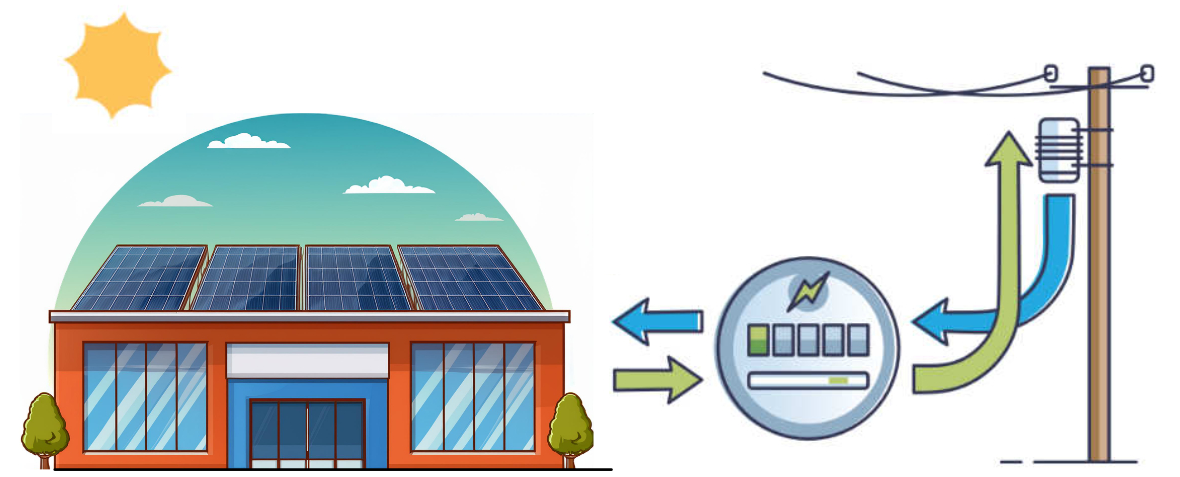
Net metering enables Burlington Hydro customers who generate more power than they consume to receive credit on their electricity bill for all surplus power delivered to the grid
For all generation projects, contact Burlington Hydro at
DER Application Process for Projects Greater than 12kW
In order to be eligible for a DER energy project, the proper application process, set by the LDC (hereinafter referred to as Burlington Hydro), must be completed by the Applicant and approved by Burlington Hydro. Please note that the Applicant is responsible for monitoring the status of their application and ensuring that all deadlines are met.
Before submitting your DER connection application, please check whether your proposed DER location has available capacity by reviewing the Distribution System Capacity Information Map. This step can help you understand capacity conditions in your area and support early project planning.
Step 1 – Preliminary Consultation with Burlington Hydro (optional)
Prior to submitting an official application, the Applicant has the option to submit:
- DER – Pre Consultation Over 12KW Form
- Permission to Release Account Information form (only required if the request is submitted by a third party).
The application gives Burlington Hydro some high-level details about the project and initiates a search for connection details and available capacity.
Burlington Hydro then responds to the Applicant via email and the Applicant can review their options and decide if they would like to move forward with an official application for their net metering project.
Step 2 – Connection Application
When submitting an official application package for a Net Metering project that has a capacity greater than 12kW, up to 500kW, the Applicant must submit:
- DER - Connection Impact Assessment (CIA) Over 12kW Application - Form B (stamped by a Professional Engineer) | Instruction Guide
- Single Line Diagram (stamped by a Professional Engineer)
- Site Plans (stamped by a Professional Engineer)
- Specification Sheets for inverters and generators
- Connection Impact Assessment Application processing fee
- Protection Philosophy with Checklist
Also, an ESA Connection Authorization must be provided before the final testing and energization of the project can take place.
Soft copies of all documents should be emailed to
Burlington Hydro Inc.
Attn: Generation
1340 Brant St
Burlington ON L7R 3Z7
Note that applications will not be processed until Burlington Hydro validates that all necessary information has been properly included in the application package and the application processing fee has been received. If adjustments to the application are needed, a Burlington Hydro engineering technician will advise the applicant.
Step 3 – Burlington Hydro Review and Connection Proposal Package
Once it is confirmed that the application is valid and the Connection Impact Assessment application fees are paid, Burlington Hydro will confirm capacity for the requested project and perform a Connection Impact Assessment. If the project passes the assessment, a Connection Proposal Package is sent to the Applicant within 60 calendar days. If the project does not pass the Connection Impact Assessment, Burlington Hydro will follow up with possible next steps for the applicant.
Step 4 – Customer Acceptance of Project
As per the instructions listed in the Connection Proposal Package, the Applicant must then:
- Sign and return a DER – Connection Agreement Small & Mid-sized embedded generation facility
- Fill out and return a Schedule F: Contacts for Notice form (provided in the Connection Proposal Package)
- Pay all necessary connection fees listed in the Offer to Connect Letter (Note that this should be paid before scheduling any construction)
- Complete a pre-construction meeting with a Burlington Hydro technician (Note that Burlington Hydro requires 4 weeks advanced notice to book the pre-construction meeting)
- Construct the project as per the standards, specifications, and approved design included given with the Offer to Connect Letter.
- Submit an As-Built Single Line Diagram upon completion
The Applicant has one year from the date of the Offer to Connect Letter to energize their project. The Offer to Connect Letter is included in the Connection Proposal Package.
Step 5 – Construction and Connection
When the project has been approved by the Electrical Safety Authority, a copy of the ESA Authorization Certificate must be sent to Burlington Hydro’s Engineering Department at
Once Burlington Hydro has the ESA Authorization Certificate on file, the Applicant can then contact the Engineering Desk at
Once all deficiencies are proven corrected, the Applicant can then contact the Burlington Hydro Engineering Desk at
Step 6 – Account Maintenance and Ongoing Generation
When the project is energized and operational, Burlington Hydro will process the account changes and begin issuing credit for generated energy.
It is important to note that it is the responsibility of the project owner to monitor the status of the generation project. Burlington Hydro is not responsible for reporting on generation data or notifying the project owner if generation stops.
Example DER Fees and Connection Costs
Burlington Hydro reviews and processes Distributed Energy Resource (DER) connection requests to ensure projects can be safely and reliably accommodated on the local distribution system. As part of this process, certain fees and studies may apply depending on the size and characteristics of the proposed DER.This webpage has been prepared by Burlington Hydro Inc.’s (“Burlington Hydro”) to provide Distributed Energy Resource (“DER”) applicants with information on Hydro One’s performance related to the estimation of DER connection costs (the “Guidance Document”), in particular, but not limited to, information on what a DER applicant can or cannot expect in terms of the accuracy of the estimates that Burlington Hydro will or has provided to the DER applicant during the connection process in respect of the cost of the work to be performed by Hydro One on its distribution system and where applicable, its transmission system to connect the DER applicant’s facility to Burlington Hydro’s distribution system.
Use of the DER Guidance Document is intended solely for information purposes and does not replace Burlington Hydro’s standard connection processes described above.
Burlington Hydro may revise or update the DER Guidance Document from time to time and recommends that any person referring to the DER Guidance Document confirm it is using the most recent version.
Connection Impact Assessment (CIA) Fees
For DER facilities less than 12 kW, Burlington Hydro may require a Connection Impact Assessment (CIA) to evaluate potential impacts on the local distribution system.
Depending on the project size and configuration, a DER may qualify for a simplified CIA or may require a full CIA. Eligibility is confirmed by Burlington Hydro during the application review. The total assessment fee will not exceed the cost of a full CIA for a similar project size.
Example CIA Fee Structure (Illustrative)
| Nameplate Capacity Size | Simplified CIA Eligibility | Fee |
|---|---|---|
| 1. Small Projects ≤ 100 kW, Simplified (If project qualifies) |
Single-phase DER: • > 12 kW and ≤ 30 kW Three-phase DER: Connecting to a supply feeder with a voltage less than 15 kV: • > 12 kW and ≤ 50 kW Connecting to a supply feeder with a voltage of 15 kV or greater: • > 12 kW and ≤ 100 kW |
$1,300.00 $1,469.00 (Including HST) |
| 2. Inverter Based DER - Small Projects > 12 kW and ≤ 500 kW |
1) All inverter based Three Phase generation projects that are: a) > 30 kW and ≤ 250 kW connecting to a BHI supply feeder with a voltage less than 15 kV; OR b) > 100 kW and ≤ 500 kW connecting to a BHI supply feeder with a voltage of 15 kV or greater. 2) Single phase inverter-based generation projects applications connecting to a BHI supply feeder that are greater than 12 kW (if it does not qualify for a simplified CIA). Note: Single phase generation project applications cannot exceed 75 kW. |
$5,413.00 $6,116.69 (Including HST) |
| 3. Inverter Based DER - Mid-sized Projects > 500 kW and ≤ 10 MW |
1) All inverter based Three Phase generation projects that are: 2) > 500 kW and ≤ 10 MW connecting to a BHI supply feeder with a voltage of 15 kV or greater. |
$8,970.00 $10,136.10 (Including HST) |
| 4. BESS and Inverter Based > 500 kW and ≤ 10 MW |
1) All BESS and inverter based Three Phase generation projects that are: 2) > 500 kW and ≤ 10 MW connecting to a BHI supply feeder with a voltage of 15 kV or greater. |
$10,950.00 $12,373.50 (Including HST) |
Notes:
- Burlington Hydro CIA fees are for all generation small project types including non-exporting, net metering and energy storage.
- The CIA fees do not include the cost for Hydro One CIA or IESO SIA (if required).
- All fees subject to change without notice.
- Contact Burlington Hydro for Synchronous (Non-Inverter Based) Generator Based CIA Project fees.
- Contact Burlington Hydro for Transmission Customer Impact Assessment fees.
- Contact Burlington Hydro for IESO System Impact Assessment fees (>10MW)
If sufficient connection capacity is available, Burlington Hydro will issue a CIA along with a high‑level cost estimate for the connection work.
Cost Variance
Burlington Hydro provides examples of completed Distributed Energy Resource (DER) connection projects to help customers understand how connection costs can vary. The document below shows a selection of projects completed within the past two years and highlights where actual costs differed from initial estimates, along with the key factors that contributed to those differences.
Refer to Burlington Hydro’s Cost Variance Guidance
Other Common Costs for DERs
Burlington Hydro provides general information about common costs associated with connecting Distributed Energy Resources (DERs), including:
- Micro‑embedded generation facility connection costs
- Connection Impact Assessment (CIA) fees
- Other common connection costs for DERs with a nameplate capacity of 250 kW or less
Refer to Burlington Hydro’s General Information on Other Common Costs for DERs
Transfer Trip Costs (Hydro One)
In some cases, a DER project may require transfer trip protection. Transfer trip is a protection and control system that automatically disconnects a DER when certain conditions occur on the upstream Hydro One system, such as a fault, loss of supply, or increased risk of islanding.
Transfer trip requirements are deter mined by Hydro One, not Burlington Hydro, and typically apply to larger or exporting DER projects or where upstream system conditions require additional protection.
Transfer trip costs may include:
- Protection and control equipment
- Telecommunications infrastructure (such as leased phone lines or radio communications)
- Engineering design, testing, and commissioning
- Ongoing telecommunications or maintenance costs, where applicable
Where required, transfer trip costs form part of the overall DER connection costs paid by the customer and are identified through Hydro One’s assessment process.
For more information on transfer trip requirements, customers can refer to:
• DER Project Connection Cost Guidance – Hydro One
• Distributed Generation Technical Interconnection Requirements – Hydro One
Questions About the Process
What are the technical requirements?
For requirements and guidelines associated with the connection of an embedded generation projects greater than 12kW, please refer to the following documents:
- ESA Guidelines
- Ontario Regulations for Net Metering
- Burlington Hydro’s Conditions of Service
- Distribution System Code
- Technical Interconnection Requirements (TIR)
Where can I apply?
Forms should be submitted to
What is the approval process? Who are the governing bodies?
All application documents are reviewed and approved by Burlington Hydro in conjunction with other involved utilities and the Electrical Safety Authority.
What are the phases/stages and deadlines of the application process?
For information on the phases and deadlines of the application processes, please refer to the OEB Guide: This document is a consolidation of the procedures, timing, workflows, and template forms issued by the Ontario Energy Board (OEB) to facilitate the communication and implementation of a standardized procedure for the connection of distributed energy resources (DERs) to distribution systems (such as Burlington Hydro).
Are there any conditions that could void the application?
The application could be rejected at any time if the Applicant does not meet the necessary requirements or deadlines.
Questions About Net Metering Accounts
How will Net Metering be reflected on my account?
Once your project is energized, Burlington Hydro will automatically update your account information to reflect that it will now be a Net Metering account where credit is issued each month for generated energy.
How does my Net Metering account work?
The crediting system for net metering is solely based on generation versus consumption each month. The generated power is directly subtracted from consumed power on the statement - based on dollars. If the project generates more power than it consumes, a dollar credit bank is created and is carried over to the next month and so on for up to 12 months. Generally, projects generate more electricity than they use in the summer and use up the credit carried forward through the winter months.
Please note that income is never generated for Net Metering accounts; if there is a credit surplus left over after the 12-month period, it is zeroed out.
Your pricing options will be based on your rate class. After you apply, Burlington Hydro will review your rate class and provide the available options.
What requirements are there?
In order to activate a DER account, you must have an active load account with Burlington Hydro and your generation project must have a bi-directional meter installed. A bi-directional meter can only be installed after the Net Metering application process is complete.
What about HST?
As part of the process outlined above, you are required to provide an HST registration number, if applicable. If you do not have an HST registration number, please indicate this on the connection application form. Note that after your generation credits are subtracted from your monthly bill, any amount owing to Burlington Hydro each month will still have HST included in the final total.
If I move, who should I notify and what happens to my account?
If you should sell your property and leave the Net Metering project installed at the location, the generation credit will be issued to your account until your final date as the account holder for that address. At that point the account is zeroed out. On the property transfer date (closing date) and moving forward, the generation credit will be allotted to the new generation account for that address which is created by the new property owner.
How often will I receive an account statement? What will it look like?
Just as you did with your original Burlington Hydro account, you will receive a monthly statement in the mail. The new document will look the same as your original account statement, other than it will have an extra line item added to list your generation for that month.
What are the associated fees with my account?
Your Net Metering account will have all the same monthly fees as your original Burlington Hydro account.
Can I redirect my credits to another address?
No. Credits are directly applied to the account on which they are generated.
Will my monthly statement change?
The layout of your monthly statement from Burlington Hydro does not change; the only difference is that any generated credits are subtracted from your total amount owing.
Common terms used or related to DER
| Term | Meaning |
|---|---|
|
DG Disconnect |
DG Disconnect is a device used to disconnect the distributed generator from the utility distribution system. This disconnect ensures the safety of electrical utility workers by allowing them to disconnect the generator from the utility system in case they have to service or repair the electrical supply. |
|
Distributed Generation |
Employs small-scale renewable energy technologies to produce electricity close to the end users of power. |
|
Export Capacity |
Export capacity is the maximum amount of electricity that a DER is permitted to export to the distribution system at any one time. Export capacity may be equal to or lower than the DER’s nameplate capacity and is established through the connection assessment and approval process. |
| Generation Credit | Once a Net Metering contract has been fully executed, the local distribution company will credit the supplier’s account for the electricity generated by the facility. |
| Inverter | An electrical device that converts direct current (DC) into alternating current (AC). Inverters are commonly used to supply AC power from DC sources such as solar panels or batteries. |
| kW | Kilowatt. A unit of electric power. |
| LDC | Local Distribution Company. This term refers to your local hydro utility (i.e. Burlington Hydro). |
| Nameplate Capacity | A project’s total installed rated capacity to generate electricity. |
| Renewable Fuel | Wind, solar photovoltaic (PV), battery storage, Renewable Biomass, Biogas, landfill gas or water power. |
| Renewable Generating Facility | A facility that generates electricity exclusively from a Renewable Fuel (i.e. solar). |
| RPP Pricing | Customers may choose between three different structures of electricity pricing: Tiered, Time-of-Use, or Ultra-Low Overnight |
| SCADA | Supervisory control and data acquisition (SCADA) is a system of software and hardware elements that monitor, gather, and process real-time data. |
| Solar Array | A linked collection of solar panels. |